
Guides
NFTs
What NFTs are, how ERC-721 and ERC-1155 differ, and how to read game collections and marketplaces on Web3Raider.
Introduction
When a Web3 game says you own a card, avatar, skin, or land plot, it usually means you hold an NFT: an on-chain ownership record for a specific digital asset. That record lives in a smart contract on a specific network. The artwork and trait list you see in a wallet are usually off-chain metadata, not the bytes stored in the ledger.
Games can be fully playable without NFTs. When collectibles exist, they are often optional: trading, collection goals, or rewards. They are not automatically a PvP edge over free in-game items.
This guide is for players and collectors on Web3Raider. If which chain the collection lives on is unclear, read Chains & Layers first. If connect and sign are new, see Wallets.
The sections below walk through what you actually own on-chain, ERC-721 vs ERC-1155, how metadata and marketplaces fit, how Web3Raider surfaces collections, and mistakes that cost people assets.
What you actually own
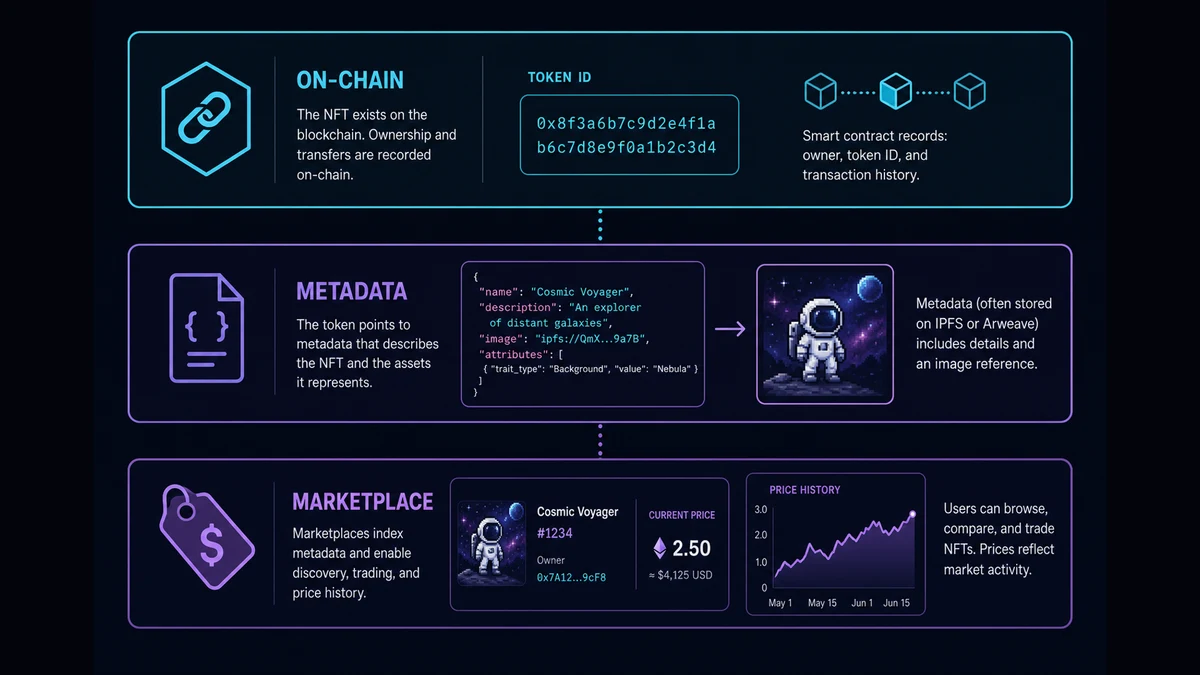
Players often mix three layers that do different jobs:
On-chain
Contract address + token ID (+ balance for ERC-1155)
0xABC… token
#42, balance
3
Metadata
Off-chain JSON: name,
image,
attributes
Card name, art URL, rarity trait
Marketplace
Listings, buy/sell UI, discovery filters
OpenSea, TokenTrove, and studio markets
The blockchain enforces who owns which token. Metadata makes that token readable in wallets and on sites. Prices usually come from marketplaces, not from the NFT contract itself.
Rule of thumb: For valuable assets, treat official contract + chain + studio marketplace links as the verification path. Metadata URIs and hosting can change; a pretty image alone is not proof.
ERC-721: one unique token per ID
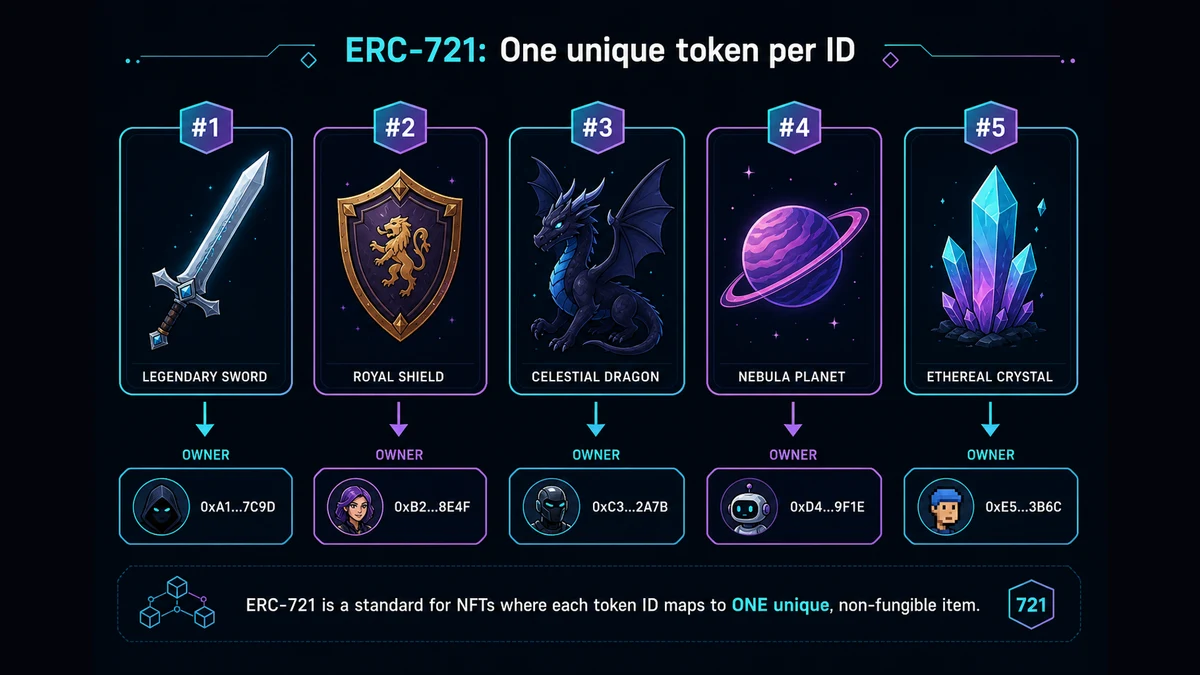
ERC-721 (opens in new tab) (ethereum.org overview (opens in new tab)) is the classic NFT standard on Ethereum-compatible chains. Each token ID is a distinct asset. One ID has one owner at a time (except during a pending transfer or sale).
Typical gaming uses
- Unique avatars and profile collectibles
- 1/1 items, exclusive characters, single land parcels
- Drops where every mint is its own on-chain ID
How Web3Raider reads ERC-721
- Expect one catalog row per token ID, often with effective supply 1
- The same name and art on different IDs are separate mints, not one stackable type
Catalog example: Parallel Avatars on Ethereum is a typical ERC-721-style set (unique IDs per avatar).
ERC-1155: one token type, many copies
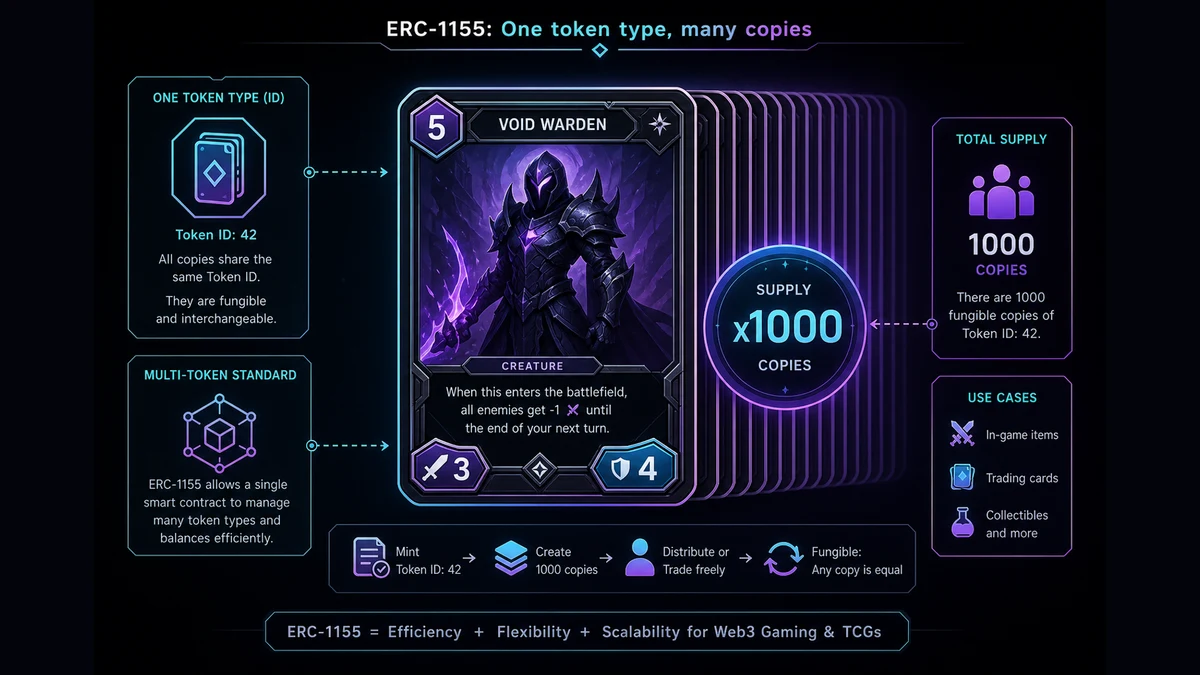
ERC-1155 (opens in new tab) (ethereum.org (opens in new tab), OpenZeppelin contracts (opens in new tab)) is a multi-token standard. One contract can manage many token IDs. Each ID has its own supply: how many units exist for that type.
- Supply = 1 → unique-like behavior for that ID
- Supply > 1 → fungible or semi-fungible copies (many stackable units of the same type, for example thousands of the same card)
Typical gaming uses
- Trading card games and fixed-edition card sets
- Stackable items, consumables, and mixed economies in one contract
- Batch transfers (move several IDs in one transaction), often cheaper than many ERC-721 transfers
How Web3Raider reads ERC-1155
- Expect one entry per token type with a supply count
- That matches how TCG and stackable item designs work on-chain
Catalog example: Parallel is a multi-collection franchise: mostly ERC-1155 TCG and cosmetics on Ethereum or Base, plus Avatars (ERC-721) and Sanctuary on B3. Read it as a both-standards pattern, not as a Parallel product clone.
ERC-721 vs ERC-1155 at a glance
The standard a collection uses changes how your wallet shows inventory and how marketplaces list or batch-transfer items. ERC-721 and ERC-1155 are the labels you will see most often on explorers and collection pages; many games use both under one brand.
Aspect | ERC-721 | ERC-1155 |
|---|---|---|
Identity | Each token ID is unique | Each token ID is a type; supply can be 1 or many |
Typical supply per ID | 1 | 1 to millions |
Gas (many items) | Often higher (one transfer per token) | Often lower (batch transfers) |
Best for | 1/1 collectibles, unique characters | TCG cards, stackable items, mixed asset contracts |
Web3Raider list view | One row per token ID | One row per token ID + supply |
Neither standard replaces the other. Many franchises use both: unique avatars (721-style) and card sets (1155-style) under one brand. Token standard is orthogonal to chain choice; match network + contract first, then read the standard.
Metadata and collection images
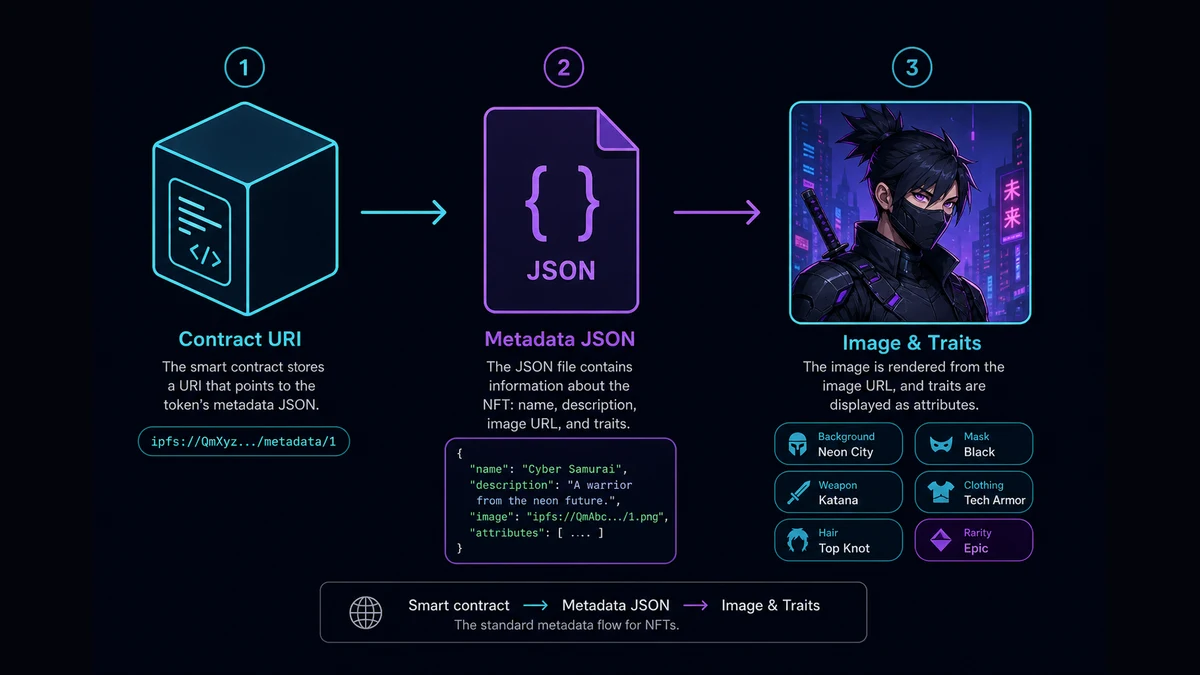
The chain records who owns which token. It does not usually store the full card art, name, or traits. Storing large files on-chain is slow and expensive. Instead, the contract stores a URI to JSON hosted elsewhere. Wallets, marketplaces, and Web3Raider follow that URI to render the NFT.
Think of a library shelf number (on-chain) versus the catalog card with title, summary, and cover (off-chain metadata).
Two levels of metadata
Collection (whole set)
Function: contractURI() on the smart
contract
Collection name, description, and cover or banner before you open individual items.
Single token (one card or item)
Function: tokenURI(tokenId) (ERC-721) or
uri(tokenId) (ERC-1155)
That token’s name, image, and attributes (rarity, faction, class, and similar traits).
What happens when you view an NFT
- A wallet or site reads contract address and token ID on-chain.
- It calls the contract and receives a URI (
https://…oripfs://…). - It downloads the JSON at that URI.
- It loads the image URL inside the JSON and shows name + traits.
Simplified JSON shape:
{
  "name": "Example Card",
  "description": "Short description of the asset.",
  "image": "ipfs://bafy.../card.png",
  "attributes": [
    { "trait_type": "Rarity", "value": "Legendary" },
    { "trait_type": "Faction", "value": "Earthen" }
  ]
}
Field | What it means |
|---|---|
| name | Display title (card or character name) |
description | Longer text; optional |
| image | Link to the artwork (PNG, GIF, and similar) |
attributes | Traits for filters and rarity (common in games) |
IPFS in one sentence
Many projects use IPFS (ipfs://… + a CID): content-addressed storage rather than one company’s server. If the file changes, the CID (and link) changes. Apps usually resolve ipfs:// through an HTTPS gateway so browsers can load images. See IPFS docs (opens in new tab).
Collection images vs marketplace images
- From the contract (
contractURI): official collection metadata used by many indexers for covers. - From marketplaces: extra curation, banners, and trading UI. Helpful for discovery; not always identical to on-chain metadata.
When Web3Raider shows a collection cover, we prefer official on-chain or curated static assets. Live token grids (where configured) use per-token metadata from indexers.
Marketplaces and trading
Buying and selling usually happen on a marketplace, not inside the NFT contract itself:
- Connect a wallet on the correct chain (see Chains & Layers).
- Approve the marketplace to transfer the NFT when you list or sell. Read the spender and scope before you sign; see Smart contracts for approval depth.
- Pay in the listing currency the market shows (ETH, POL, and similar), and keep a little native gas on that chain.
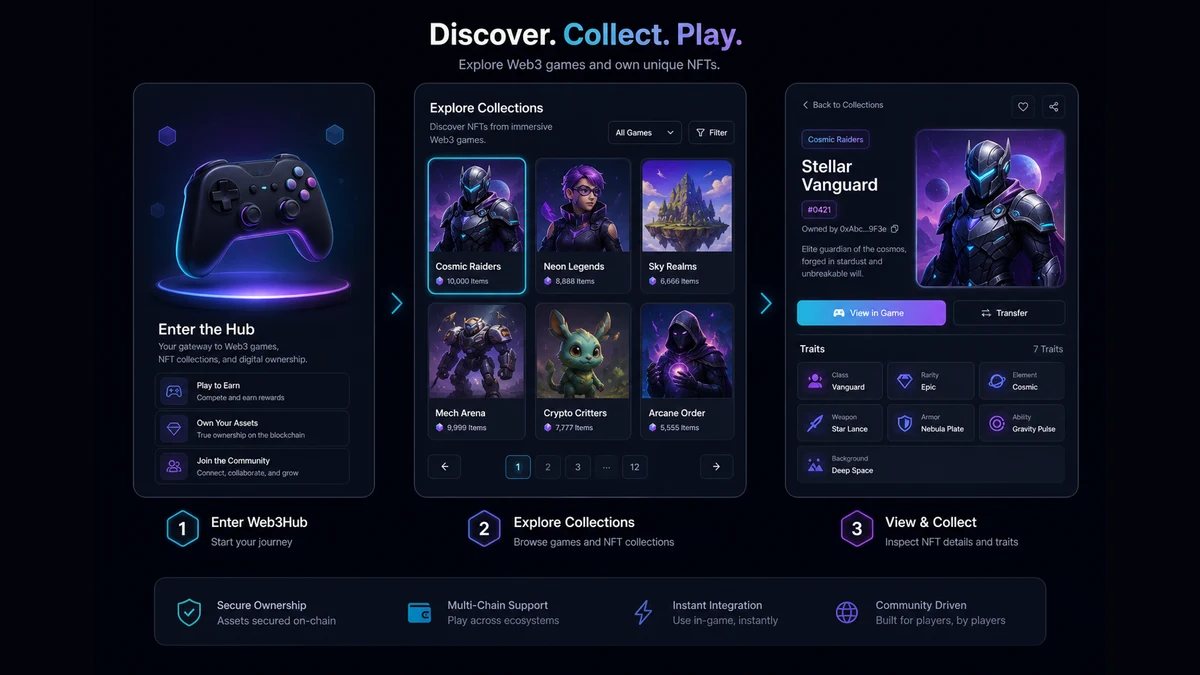
Web3Raider surfaces official marketplace links on collection pages under /nft. Use those (or the studio’s docs) over random search results. Trading involves risk, fees, and regional availability; this edu page does not chase live floors or TVL.
On a Web3Raider collection page, confirm network badge, contract, and marketplace link together before you buy. Same brand on two chains usually means two contracts (and often two collection pages). Match the wallet network to the page you are on.
How Web3Raider uses NFTs
- /nft is the collections hub: discovery across games, with network and marketplace context when configured.
- /games pages list franchise Collections so you can move from a title to its sets.
- /blockchain lists supported networks; use network Guide tabs (for example Ethereum or Base) when you need chain depth after this page.
- Collection pages show description, network, official links, and optional live grids. Prefer those links over lookalike collections with similar art.
We add collections and live indexers incrementally. This guide stays standard-agnostic so it remains useful as the catalog grows. Web3Raider is a parallel catalog: check contract + chain on the collection page (and studio docs) before you treat a listing as the same asset.
Common mistakes
Fake collections with lookalike art
Verify contract address and chain against studio docs or the Web3Raider collection page. Matching art alone is not enough.
Wrong-chain listings
Filter the marketplace to the network on the collection page. A correct address on the wrong chain is still the wrong asset.
Metadata bait-and-switch
URIs and hosting can change. For high-value buys, confirm official contracts and studio marketplaces, not only the current thumbnail.
Phishing “mint” sites
Prefer links from the game’s official site or our collection pages. Do not paste seed phrases into mint forms.
Broad marketplace approvals without checking the spender
Read what you are approving. Unlimited or unexpected spenders are a common drain path; revoke unused approvals after high-risk sessions.
Further reading
- ERC-721 (EIP-721) (opens in new tab)
- ERC-1155 (EIP-1155) (opens in new tab)
- Ethereum.org: ERC-721 (opens in new tab)
- Ethereum.org: ERC-1155 (opens in new tab)
- OpenZeppelin: ERC-1155 contracts (opens in new tab)
- IPFS docs (opens in new tab)
- Web3Raider: Chains & Layers
- Web3Raider: Wallets
- Web3Raider: Smart contracts
- Web3Raider: NFT collections
- Web3Raider: Networks & tokens
Token standards, metadata hosting, and marketplace UIs change; confirm contract, chain, and official links on project documentation before high-value transfers.