
Guides
Chains & Layers
How blockchain networks and scaling layers work for Web3 games: L1, L2, gaming chains, and why assets live where they do.
Introduction
When a Web3 game talks about owning a card, avatar, or land NFT, it almost always means owning a token on a specific blockchain network. That network is not interchangeable with others: the same wallet address on Ethereum and on Base holds different assets, under different smart contracts, with different fees.
This guide explains chains (networks you connect to in a wallet) and layers (how those networks relate, especially Ethereum Layer 1 and Layer 2). It is written for players and collectors using Web3Raider, not for protocol engineers.
The sections below walk through what a chain is, how L1 and L2 relate, why games split assets across networks, and how to match wallet, marketplace, and contract before you buy or bridge.
What is a blockchain network?
A blockchain (or chain) is a shared ledger maintained by many computers. For gaming assets, what matters day to day:
- Which chain your NFT or token exists on
- Which native token pays fees (usually ETH on Ethereum-compatible networks)
- Which explorer and marketplace show your inventory for that chain
Term | Plain meaning |
|---|---|
Network / chain | The environment your wallet must select (e.g. Ethereum, Base, Immutable) |
| Native token | Coin used for gas and often shown as “balance” (ETH, POL, IMX, etc.) |
Contract address | The program that minted your NFT, valid on one chain only |
Block explorer | Website to verify contracts and transactions (Etherscan, Basescan, etc.) |
Rule of thumb: Always confirm chain + contract address together. A correct address on the wrong network is still the wrong asset. See Smart contracts.
Layer 1 (L1)
Layer 1 is the base blockchain that provides final settlement and security for its ecosystem. For most Web3 games in our catalog, Ethereum mainnet is the reference L1: high security, global liquidity, and the chain many legacy collections were minted on.
Other L1s exist as independent foundations (e.g. Solana, Sui, Avalanche). They have their own wallets, explorers, and NFT standards. A studio may launch on an L1 for speed and cost, or bridge assets later. Each choice has trade-offs for players (wallet setup, marketplace support, bridging risk).
Why games still use Ethereum L1
Established marketplaces, collector prestige, and early mint history. High-profile avatars and “genesis” sets often stay on L1 even when day-to-day play moves elsewhere.
Why games avoid doing everything on L1
Gas fees spike when the network is busy. Minting thousands of in-game items or trading small-value cards on L1 alone can price out casual players.
Layer 2 (L2) and rollups
Layer 2 networks scale Ethereum by executing most transactions off Ethereum mainnet, then posting compressed data (and proofs) back to L1. Rollups inherit Ethereum’s security model for that posted data. They are not random clone chains with no link to L1.
Ethereum.org — What is layer 2? (opens in new tab) describes L2 as separate blockchains that extend Ethereum. The two dominant rollup families:
Type | Idea | Examples (2025–2026) |
|---|---|---|
Optimistic rollup | Transactions assumed valid; fraud proofs if challenged. [details] | Arbitrum One, Base, OP Mainnet |
| ZK rollup | Validity proofs submitted to L1. [details] | zkSync Era, Linea, Scroll, Starknet |
For players, the practical difference is usually fees and wallet network, not the proof system. Pick the chain the studio documents for that collection.
Why L2 fees dropped for gaming (EIP-4844)
Before the Dencun upgrade (March 2024), rollups posted transaction data to L1 in expensive formats. EIP-4844 (opens in new tab) introduced blob space: cheaper data lanes for rollups. Industry data showed much lower L2 transfer costs afterward (often cents or fractions of a cent), making high-frequency actions (small trades, mass mints) viable for games.
Ethereum.org — Danksharding / proto-danksharding (opens in new tab) explains blobs as a stepping stone toward even more rollup capacity. For gamers: post-2024 L2 is the default place many studios mint and trade everyday items.
Major Ethereum L2s you will see
Network | Role in gaming (typical) |
|---|---|
| Base | Consumer-friendly L2; many new drops and social/trading apps |
| Arbitrum One | Large DeFi and gaming liquidity; app-specific chains (Orbit) |
| OP Mainnet | OP Stack ecosystem; shared tooling with Base |
| zkSync / Linea / Scroll | ZK-rollup alternatives; growing NFT and game tooling |
These are EVM-compatible: same address format (0x…), similar wallets (MetaMask, Rabby, etc.), and often the same marketplaces with a chain filter.
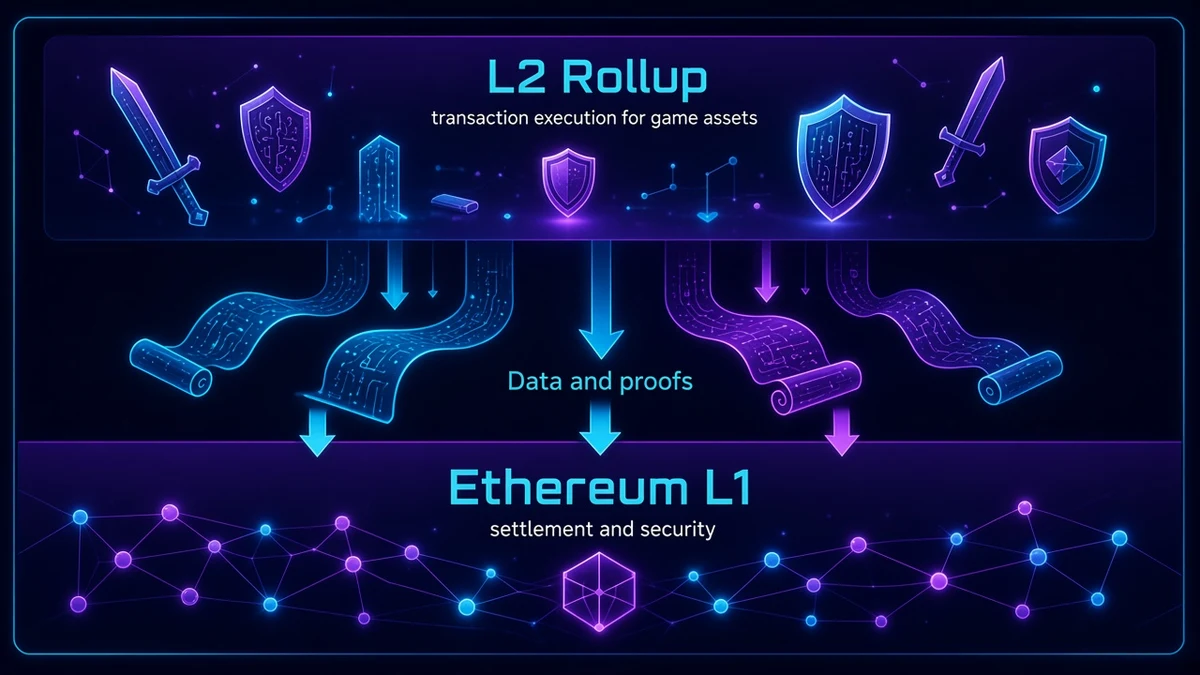
Not every “cheap chain” is a rollup
Confusing labels cause lost funds. Short distinctions:
Rollup (L2)
Settles to Ethereum L1; security tied to posted data/proofs. Base, Arbitrum, Optimism, most zkEVM L2s.
Sidechain
Separate validator set; bridge to Ethereum. Cheaper, different trust model. Some older “Polygon” activity referred to PoS sidechain usage vs newer zkEVM L2.
App / game chain
Network optimized for one ecosystem (high throughput, studio tooling). May be an L2, an L3 on top of an L2, or a legacy dedicated chain migrating toward Ethereum L2.
Non-EVM L1
Different address formats and wallets (e.g. Solana, Sui). Games here are not “on Ethereum” even if the brand also has EVM collections.
When a project says “we’re on Polygon,” check whether they mean Polygon PoS, Polygon zkEVM (Ethereum L2), or a gaming subnet. Explorers and bridges differ.
Gaming-focused networks
General-purpose L2s host games too, but some networks market themselves as gaming infrastructure:
Immutable (zkEVM and legacy Immutable X)
Immutable targets Web3 games: NFT minting, marketplaces, passport/wallet flows, and indexer APIs. Historically the ecosystem ran Immutable X (StarkEx-based, strong for gas-efficient NFT trades, limited general smart contracts) alongside Immutable zkEVM (EVM-compatible, full Solidity contracts, lower gas than L1).
Industry reporting in 2026 describes a merge toward one unified Immutable chain to reduce developer and player confusion. If you hold older assets, follow official migration guides. Contracts and RPC endpoints can change during consolidation.
In our catalog: collection pages such as Gods Unchained Cards show the Immutable network and contract used for live asset views.
Dedicated chains and “moving to Ethereum L2”
Some franchises started on their own chain (custom validators, game-specific bridge) and later migrated or anchored to Ethereum L2 for security and liquidity. That pattern signals maturity of rollup tooling, not that “Ethereum won” every game category overnight.
Other studios deploy an application chain (sometimes called L3) on top of Arbitrum or similar: custom gas token, game-specific sequencing, still rooted in a wider L2 ecosystem.
Non-EVM gaming L1s
High-performance L1s (Solana, Sui, etc.) remain common for action games and compressed NFT standards. Web3Raider may list these over time; the same lesson applies: chain in the wallet must match the mint, and marketplaces are chain-specific.
One game, multiple chains
Studios split assets across networks for cost, audience, or product design.
Pattern A: Separate deployments (most common)
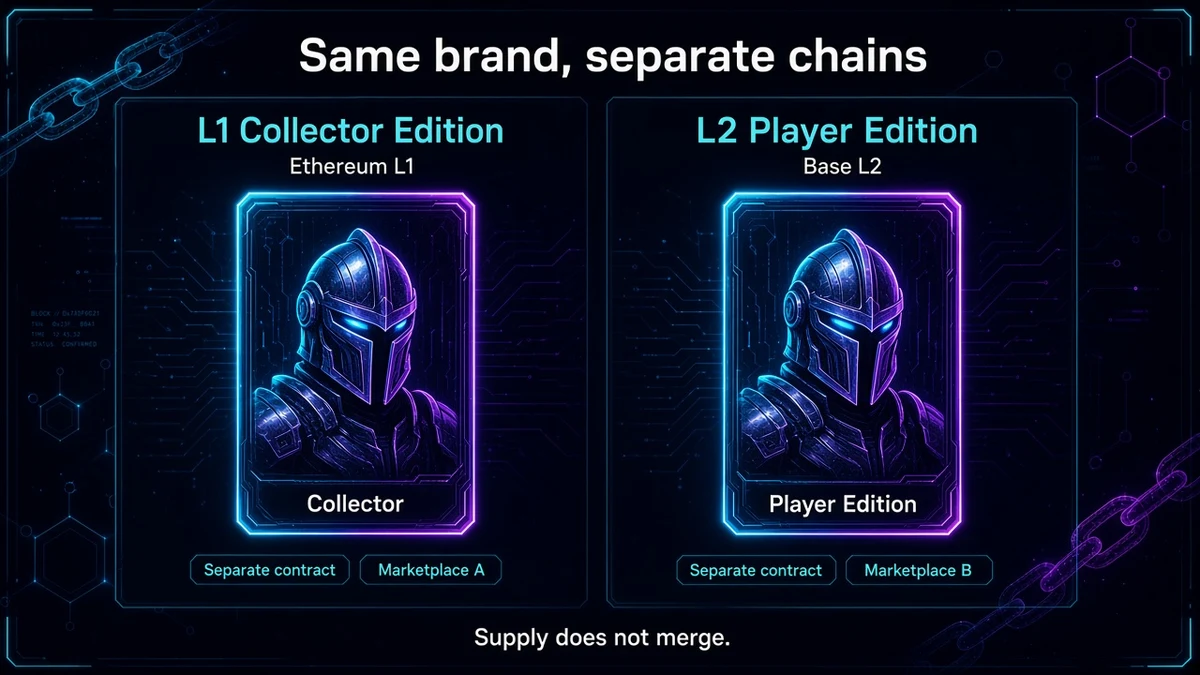
The same brand (e.g. “Expansion X”) launches as two contracts on two chains:
- Different contract addresses
- Often different OpenSea collection pages
- Supply and holders do not merge automatically
Example pattern (generic): collector edition on Ethereum L1, mass-market player edition on an L2: two listings, two covers, two explorer links.
Pattern B: Bridged asset
A token minted on chain A is locked and a wrapped copy appears on chain B. Bridging adds bridge contract risk and UI steps. Read official bridge docs; do not assume “same NFT” across chains without verification.
Pattern C: Token on L2, governance on L1
Ecosystem tokens (governance/rewards) may exist on both Ethereum L1 and an L2 (e.g. bridged PRIME-style setups in multi-chain franchises). NFT card contracts are still separate from ERC-20 token contracts. Do not confuse them when verifying addresses.
On Web3Raider, each collection page shows which network(s) that entry is about (badges and marketplace links). When a franchise ships the same brand on two chains, we usually publish two collection pages (one slug per contract and chain), so you do not mix L1 and L2 inventory. Less often, a single page covers one primary deployment and still links out to marketplaces on more than one network. Always confirm the network on the collection page, then match it in your wallet and on the official docs before you buy or bridge.
EVM compatibility and your wallet
EVM (Ethereum Virtual Machine) chains share:
0xaddresses and similar transaction format- Wallets that let you “Add network” or auto-switch
- Tooling familiar to Solidity developers
Switching network in the wallet changes which balances and NFTs you see. Sending an NFT to an address on the wrong chain can mean lost funds or a painful recovery via official bridge support only.
Checklist before you buy or accept a transfer:
- Network shown in wallet matches the collection page on Web3Raider
- Marketplace URL is filtered to that network (OpenSea, etc.)
- Contract address matches official docs or explorer
- You have a small amount of native gas token on that chain
Gas, speed, and what players feel
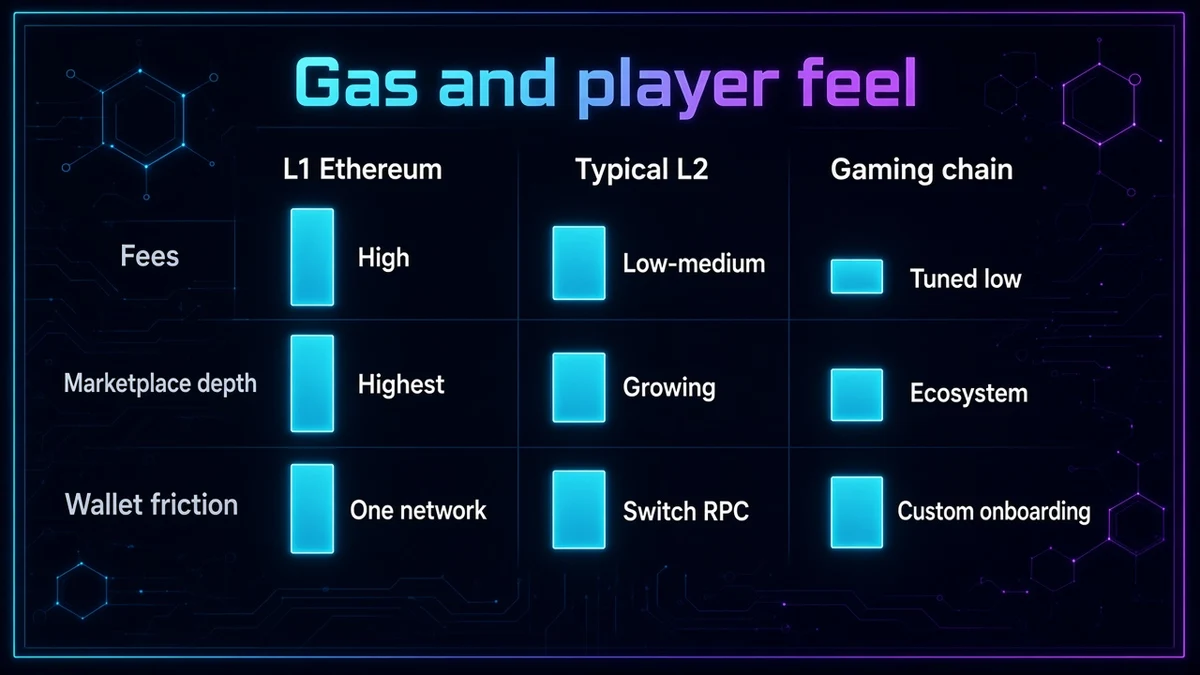
Factor | L1 Ethereum | Typical L2 | Dedicated gaming chain |
|---|---|---|---|
| Security anchor | Self | Ethereum (rollups) | Varies |
| Fee during hype | High | Low–medium | Often tuned low |
| Marketplace depth | Highest for legacy NFTs | Growing fast | Ecosystem-specific |
| Wallet friction | One network | Must switch RPC | Often custom onboarding |
Gameplay itself (matchmaking, FPS, anti-cheat) still runs off-chain on studio servers. Chain choice affects ownership, trading, and mints. See Smart contracts: On-chain vs off-chain.
How Web3Raider uses chains
- /blockchain lists networks and tokens tied to games in the catalog (expandable over time).
- /nft collection cards show network badges linked to catalog pages when configured.
- Collection pages link marketplaces and, for supported indexers, live NFT grids.
- Other chains may show metadata, covers, and official links while on-chain grids are added later.
We add chains and games incrementally; this guide stays network-agnostic so it remains useful as the catalog grows.
Choosing the right network (quick reference)
You want to… | Do this |
|---|---|
Buy a listed collection NFT | Use the chain on the official marketplace link from Web3Raider |
| Verify a contract | Open the explorer for that chain (Etherscan, Basescan, Immutable Explorer, …) |
Understand token type | Read NFTs (ERC-721 vs ERC-1155); orthogonal to chain choice |
Move asset to another chain | Use only the project’s official bridge; never “send to same address” on another network blindly |
Common mistakes
Wrong network in wallet
NFT “not found” or failed mint: switch to the chain the studio documents.
Assuming one OpenSea page covers all chains
Filter by chain; bridged or L2 collections often have separate slugs.
Treating L2 as “fake Ethereum”
Rollup assets are real on that L2; they are not automatically visible on L1 without a bridge.
Confusing game token with NFT contract
Reward tokens and card contracts have different addresses. Verify each on the correct chain.
Network guides on Web3Raider
Each catalog network has a Guide tab on its hub (/blockchain/networks/[slug]). Start here when you know which chain a game uses:
Further reading
- Ethereum.org — What is layer 2? (opens in new tab)
- Ethereum.org — Scaling (opens in new tab)
- EIP-4844 — Shard blob transactions (opens in new tab)
- Ethereum.org — Optimistic rollups (opens in new tab)
- Ethereum.org — Zero-knowledge rollups (opens in new tab)
- Web3Raider — Wallets
- Web3Raider — Smart contracts
- Web3Raider — NFTs
- Web3Raider — Networks & tokens
Networks, merges (e.g. gaming L2 consolidations), and fee markets change; confirm chain and contract details on official project documentation before high-value transfers.